
Good skin lesion removal aftercare comes down to three simple things: keep the treated area clean, protect it from the sun, and give your skin time to heal. How you care for the spot matters just as much as the removal itself.
Different routines depend on the technique used to remove the skin lesion. Healing occurs differently depending on whether the skin is closed with stitches, treated with laser, or treated with cold therapy. All techniques have their own ways of healing, but the little things matter.
This manual will discuss how proper healing occurs, typical healing times, and simple steps to achieve clean healing without infections, keloids, or skin discolouration.
Key Takeaways
- Keep the area clean and dry, and avoid touching it for the first day or two.
- Sun exposure is the biggest cause of dark marks while skin heals, so cover up.
- Most wounds heal within one to three weeks, depending on the method used.
- Let scabs and crusts fall off on their own; never pick them.
- See a doctor if you notice spreading redness, swelling, pus, or a fever.
Wound Care After Lesion Removal: Day by Day
If you want to know how to look after skin after lesion removal, the day-to-day routine is easy to follow. These simple steps cover almost every method:- Keep it clean and dry. Gently clean the area as advised and pat it dry; do not rub.
- Leave scabs alone. Let the crusts fall off on their own to avoid scarring.
- Protect it from the sun. Once healed, use a high-factor sunscreen (SPF 30 or above) on the area for several months.
- Hold off on harsh products. Skip acids, retinoids, and scrubs until the skin has fully recovered.
- Take it easy at first. Avoid heavy exercise, swimming, and saunas for the first few days.
- Attend your follow-up. It lets the doctor check healing and remove any stitches.
How It Works: Aftercare for Each Removal Method
How we remove the lesion determines your aftercare. The tool decides what your skin needs next, so here is what to expect from each method.After Minor Surgery (Stitches)
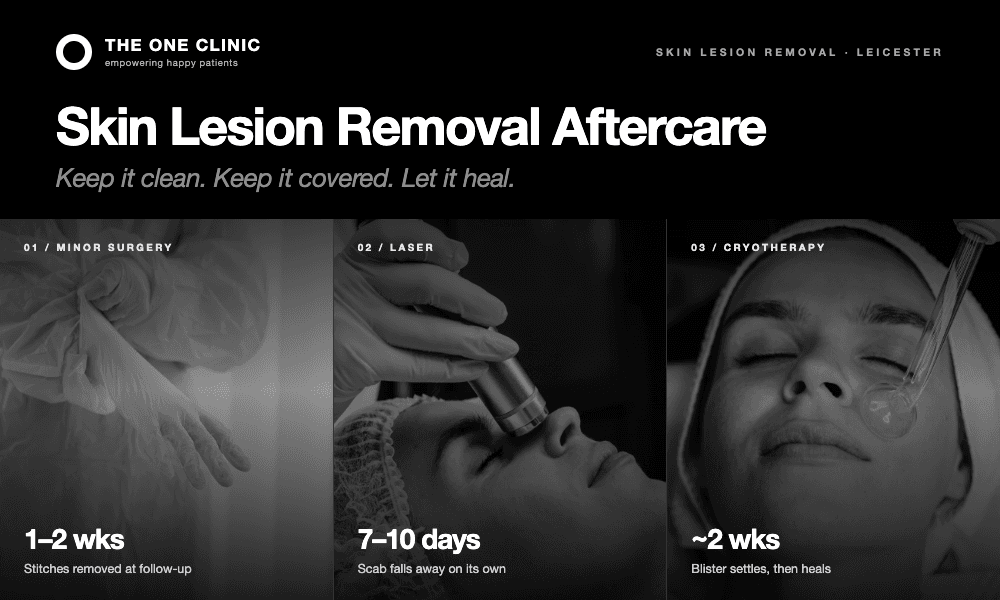
Doctors often use minor surgery for deeper lesions, such as cysts and lipomas, or for larger moles. We numb the area with a local anaesthetic, remove the lesion, and close the skin with fine stitches. Good wound care after lesion removal with stitches keeps things simple:- Keep the dressing clean and dry, and follow our instructions for changing it.
- Avoid stretching or knocking the area while it heals.
- Return for your follow-up so the stitches can be removed safely, usually after one to two weeks.
Do you worry that removing the lump might leave a scar?
- The doctors at The One Clinic first check every lesion and choose the gentlest, most suitable method to keep the finish neat
- Many treatments need no stitches at all
After Laser Removal
Laser works well for smaller, flatter moles and some skin tags. The One Clinic uses the Asclepion Dermablate, an Er: YAG laser that targets water within skin cells. Because of this, it removes the lesion layer by layer, with less heat spreading to the surrounding skin. Looking after the area after mole removal aftercare with a laser is straightforward:- Expect redness a bit like mild sunburn, plus a small scab.
- The scab usually falls off on its own within seven to ten days.
- There are no stitches, and full healing takes a few weeks.
After Cryotherapy (Freezing)
Cryotherapy uses very cold liquid nitrogen to freeze the lesion away. It is a quick, popular choice for skin tags and warts. Aftercare for skin tag removal by freezing is gentle, but the area may react for a short while. Sensible cryotherapy aftercare includes:- A blister or scab may form within a day or two; this is normal.
- Keep the area clean and dry, and let any blister settle on its own.
- Allow the scab to drop off naturally rather than picking it.
- The treated spot usually heals within about two weeks.
Skin Lesion Removal Recovery Time
Recovery is rarely long, but it does vary. Your skin lesion removal recovery time depends on the method used, the size and depth of the lesion, its location on your body, and your skin type. As a general rule, the lesion healing time after each method is:- Laser: the scab detaches after 7 to 10 days; the healing process takes a couple of weeks.
- Surgical removal with sutures: healing takes one to two weeks, followed by scar formation that fades after a couple of months.
- Cryotherapy or shave removal: the small wound usually heals within two weeks.
Symptoms of Normal Healing vs Signs of Infection
It helps to know what is normal so you do not worry over every twinge. Removing a lesion changes the skin, so some healing signs are simply part of the process. Normal healing usually looks like this:- Mild redness around the area
- Light swelling for a day or two
- A small scab or crust forming over the spot
- Gentle itching as new skin grows
- Pain that gets worse instead of better
- Redness that spreads outwards from the wound
- Heat, swelling, or throbbing
- Yellow or green discharge, or a bad smell
- A high temperature or feeling unwell
Has a previous skin treatment left you with a dark mark?
- The medical team in Leicester chooses laser settings with your skin tone in mind to help protect the area as it heals
Look and Feel Your Best Every Day!
- •Advanced facial, body, and hair treatments.
- •Tailored solutions for lasting confidence.
- •Caring support at every step.

.png&w=3840&q=75)
.png&w=3840&q=75)