The safest way to deal with itchy skin lesions is to get an accurate diagnosis from a doctor and then treat the cause directly, rather than reaching only for an over-the-counter cream. An itchy spot, bump, or patch can come from many different things, so the right treatment depends entirely on what is actually causing it.
We define lesions as any skin changes that appear and behave differently from the surrounding area. Some may be harmless, while others indicate an infection, an immunity issue, or even a growth that requires adequate treatment. As they all have similar appearances, a diagnosis would never be possible, and any attempt to scratch the affected area would worsen the condition.
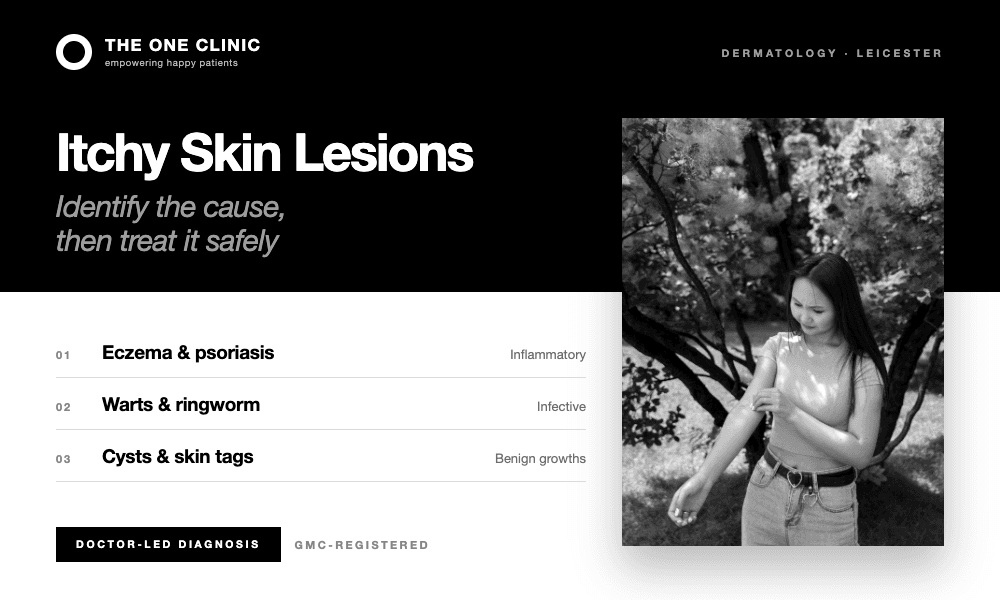
There are various reasons someone may experience itchy skin lesions, including eczema, psoriasis, urticaria, skin infections and viruses, and benign skin growths like cysts and skin tags. This guide will help you better understand these conditions, their symptoms, and treatment options.
Key Takeaways
- Itchy skin lesions are abnormal patches of skin that cause a constant urge to scratch.
- There are many causes of such a phenomenon, including eczema, psoriasis, fungal infection, viral infection or benign skin growth.
- An accurate, doctor-led diagnosis is the safest first step.
- Treatment may involve prescription medications, cryotherapy, curettage, laser therapy, or minor surgery, depending on the diagnosis.
What Are Itchy Skin Lesions?
A skin lesion is any patch of skin that has an abnormal growth or appearance compared with the skin beside it. When that area also makes you want to scratch, doctors call it a pruritic skin lesion; pruritic simply means itchy.
These lesions take many forms. You might notice flat marks, itchy bumps on skin, scaly patches, or itchy raised skin lesions that sit slightly above the surface. Some are soft, some are firm. Some appear on their own, while others spread across an area.
Doctors often describe them by shape:
- Macules: small, flat, discoloured spots
- Papules: small, raised bumps
- Plaques: larger, raised, flat-topped areas
- Nodules: firmer lumps that sit deeper under the skin
Whatever the shape, an itchy lesion is a physical change in the skin or an active inflammatory response. That is why skincare alone rarely shifts it. There is usually something underneath driving the itch.
Causes of Itchy Skin Lesions
Itchy lesions appear when the skin reacts to a trigger. The skin is a living organ, and the itch is its way of signalling that something is wrong. Most causes fall into a few groups:
- Inflammatory skin conditions: eczema (atopic dermatitis), psoriasis, and hives (urticaria) cause the immune system to overreact, leaving red, itchy, and sometimes scaly skin.
- Fungal infections: ringworm and similar infections create itchy, scaly, often ring-shaped patches.
- Viral infections: a virus causes warts and verrucas and can itch as they grow.
- Allergic and contact reactions: soaps, metals, plants, or new products can trigger an itchy rash where they come into contact with the skin.
- Benign growths: cysts, skin tags, and seborrhoeic keratoses can become itchy when they catch or rub against clothing.
Many people first notice itchy red spots on skin that seem to come and go. Treating only the itch, without tackling the cause, is a bit like painting over a crack in a wall: the surface looks better for a while, but the real problem stays put. A doctor will first identify the cause and may recommend removal of the
skin lesion.
Are you scratching so much that your skin is becoming red, sore, or infected?
- Over-the-counter creams often calm the surface without treating the cause
- An accurate medical diagnosis identifies the underlying cause of the itch
Book Your Dermatology Consultation
When to See a Doctor About Itchy Skin Lesions
A few warning signs can point to an infection or, rarely, skin cancer. Book a medical assessment promptly if a lesion:
- Changes in size, shape, or colour
- Has an uneven or ragged border, or more than one colour
- Bleeds, oozes, or forms a crust
- Does not heal within a few weeks
- Grows quickly or starts to look very different from your other spots
- Appears alongside a fever, a spreading rash, or feeling unwell
If you have several lesions and are unsure what they are, it is always safer to have them checked at a doctor-led skin clinic than to watch and wait.
How It Works: Diagnosis and Treatment
Safely clearing an itchy lesion starts with knowing exactly what it is. A reliable process usually follows a few clear steps:
Consultation
The visit begins with an unhurried, face-to-face appointment. The doctor asks about your symptoms, how long the lesion has been there, and anything that makes it better or worse.
Examination
The doctor examines the skin under good clinical lighting, sometimes with magnification, to accurately identify the lesion.
Diagnosis and Testing
Where there is any doubt, the doctor may take a small sample or remove the lesion and send it to a laboratory to check for abnormal cells.
Treatment Plan
Once the cause is clear, the doctor builds a plan matched to your skin and the type of lesion.
Taking time over the diagnosis is what makes the treatment work. The right plan for eczema looks nothing like the right plan for a cyst or a wart.
Worried that removing a stubborn, itchy lump will leave a noticeable scar?
- Trained doctors use precise surgical and laser techniques to safely remove the lesion and keep the finish as neat as possible
Speak to Our Medical Experts
Treatment Options for Itchy Skin Lesions
Every cause needs its own treatment. After the diagnosis, a doctor will recommend one or more of the following, depending on the type of lesion. The aim is always to treat the cause, ease the itch, and lower the risk of scarring.
| Treatment |
Best suited to |
Anaesthetic |
Typical downtime |
| Prescription creams or tablets |
Eczema, psoriasis, fungal infection |
None |
None |
| Cryotherapy |
Viral warts, skin tags |
None |
A few days |
| Curettage and cautery |
Raised or crusty growths |
Local |
A few days |
| Minor surgery (excision) |
Cysts, lipomas, suitable moles |
Local |
1 to 2 weeks |
| Erbium YAG laser |
Benign surface lesions |
Topical or local |
Short |
| IPL (intense pulsed light) |
Red and brown pigmented spots |
None |
Minimal |
- Prescription creams or tablets: for inflammatory or infective conditions such as eczema, psoriasis, or fungal infections, prescription-strength creams or tablets can calm the skin and treat the underlying cause.
- Cryotherapy: a targeted freezing treatment using very cold liquid nitrogen. It safely destroys tissue such as viral warts and skin tags, with minimal effect on the surrounding healthy skin.
- Curettage and cautery: the doctor gently scrapes away the lesion and seals the base. It suits certain raised or crusty growths.
- Minor surgery (excision): for deeper structural lesions such as cysts and lipomas, a doctor removes the entire lesion under local anaesthetic. Shave or punch excision can also remove suitable moles and itchy skin growths.
- Laser therapy: an Erbium YAG laser can gently vaporise certain benign surface lesions without cuts or stitches, which can mean a neat result and a short recovery.
- IPL (intense pulsed light): useful for breaking down red and brown pigmented spots near the surface.
The right choice depends on what the lesion is, where it sits, and your skin type. A doctor will talk you through the options and the likely results, which vary from person to person.
Recovery and Aftercare
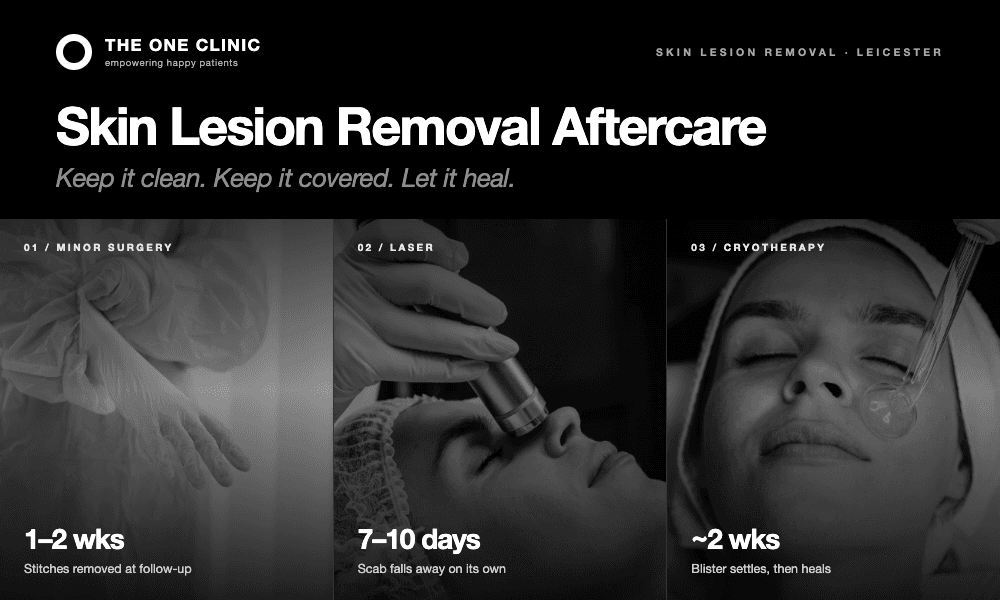
Good healing depends as much on aftercare as on the procedure itself. After minor surgery or laser removal, a few simple steps protect the result:
- Keep the area clean and dry as advised
- Protect it from the sun while it heals
- Avoid picking or scratching the treated skin
- Attend any follow-up appointments
Healing times vary with the treatment and the person. A doctor will give you clear, written aftercare advice and arrange a review to check the skin is settling well.
Conclusion
Clearing itchy skin lesions for good comes down to three things: an accurate diagnosis, a treatment aimed at the cause, and a little patience while the skin heals. Scratching, squeezing, or piling on generic creams tends to make a structural skin problem worse and can leave a scar.
Because so many different conditions can look alike, the safest route is always a proper medical assessment. Whether the answer is prescription medicine, cryotherapy, laser, or minor surgery, matching the treatment to the exact cause gives the skin the best chance of recovering and staying clear.
The experienced, GMC-registered doctors at The One Clinic offer skin lesion removal in Leicester to diagnose the cause of your itch and treat it safely, with careful aftercare from start to finish. If an itchy spot, bump, or patch is bothering you, a face-to-face consultation is the simplest place to begin.
Frequently Asked Questions
1. Why won't my itchy skin lesion go away?
For lesions that are deeply infected by a virus or fungus, or that involve a structural abnormality such as a cyst, no topical cream would reach the source; hence, they require a medical diagnosis and treatment of the underlying cause.
2. Can you remove an itchy skin lesion with a laser?
Yes. For lesions determined to be benign, non-cancerous surface lesions by a doctor, an Erbium YAG laser treatment can be performed to remove them via vaporisation. It applies only to selected cases.
3. Is it safe to remove an itchy skin bump at home?
No. Cutting, burning, or picking at a lesion at home damages healthy skin, often causes infection, and raises the risk of permanent scarring. A trained doctor should always do the removal.
4. Are itchy skin lesions contagious?
Some are. Warts, verrucas, and fungal infections can spread to other people or to other parts of your own skin, while eczema and benign growths are not contagious. A diagnosis tells you which type you have.



.png&w=3840&q=75)
.png&w=3840&q=75)